By Ruben, Ruben's Tires · Published November 28, 2026
A wheel alignment is one of those jobs that is easy to put off, because the car still drives. But an alignment that is off does not fix itself. It quietly wears your tires on one side, makes the car work harder and makes it less steady in the rain. Here is how to tell when you need one, what the shop actually adjusts, and what skipping it really costs.
What a wheel alignment is
An alignment is not a part. It is a setting: the small angles at which each wheel points and leans. When those angles match what your car's maker specifies, the tires roll straight and sit flat on the road. When they drift, the tires start to scrub and lean, and they wear unevenly. Three angles matter most.
Toe is whether the front of each wheel points in or out, seen from above. Too much toe makes the tires scrub sideways as they roll, and they wear with a feathered, saw-tooth edge.
Camber is whether the top of the wheel leans in or out, seen from the front. Too much lean puts the weight on one edge of the tire, and that edge wears fast.
Caster is the tilt of the steering axis, seen from the side. It is what makes the steering wheel come back to center after a turn. When it is uneven side to side, the car can pull.
Signs you need an alignment
The car pulls to one side. On a straight, flat road with your hands light on the wheel, the car drifts left or right. Many roads are built slightly higher in the middle so rain runs off, which can cause a small drift, so test it in a flat, empty parking lot as well.
The steering wheel is off center. You are driving straight, but the logo on the steering wheel is tilted. That is one of the clearest signs the angles have changed.
One edge of a tire is wearing faster. Run your hand across the tread. If the inside or outside edge is lower than the middle, or the tread blocks feel sharp in one direction and smooth in the other, the alignment is the first suspect.
Tires squeal on gentle turns. Squealing at normal speed in a parking lot or on a slow corner can mean the tires are being dragged instead of rolling.
The steering feels loose or wanders. This one needs care. Loose steering can come from worn steering or suspension parts, not only from alignment. A worn tie rod or ball joint is a safety problem, so get it checked the same week.
A shake in the steering wheel at highway speed is usually a balance problem, not alignment. Balancing adds small weights to the wheel so it spins evenly. Alignment sets the angles. The two are often done together, but they fix different things.
When to check it, even with no signs
Get the alignment checked after you buy new tires, so they start their life rolling straight. Check it after a hard hit on a pothole or a curb, and after any steering or suspension part is replaced, because new parts usually change the wheel angles. If you raise or lower a truck, the angles change too. Your owner's manual may also list a regular check.
Why Central Florida roads knock wheels out of line
Central Florida is flat, so people assume their wheels have it easy. They do not. Afternoon storms soak the road base, and potholes open up fast, often hidden under a puddle. Daily runs on I-4, SR-436 and SR-50 mean stop-and-go traffic, quick lane changes and curbs in tight parking lots. After a hurricane or a big storm, roads can be full of debris and washed-out patches. Any one hard hit can be enough to change the angles.
What skipping an alignment costs you
Tires, first and most. A wheel that is out of line wears one part of the tire much faster than the rest. Once that edge is worn, the tire is worn, even if the middle still has tread. That wear cannot be undone, and a pair or set of tires costs far more than an alignment check. A loose tie rod or bad angle left alone can chew up a set of tires in a few months.
Fuel. Tires that scrub instead of rolling straight add drag. The engine has to work harder to push the car down the road, so you burn more gas on every trip.
Safety in the rain. A car that pulls is a car you are always correcting. On a wet road, in heavy Florida rain, uneven tires grip unevenly, and a tire worn down on one edge cannot clear water as well.
The parts underneath. Steering and suspension parts take extra strain when the wheels fight each other. Small problems grow into bigger repairs.
The reverse matters too: if the angles are off because a part is worn, an alignment alone will not hold. That is why a good alignment starts with a look at the parts, not only the machine.
What happens during an alignment at our shops
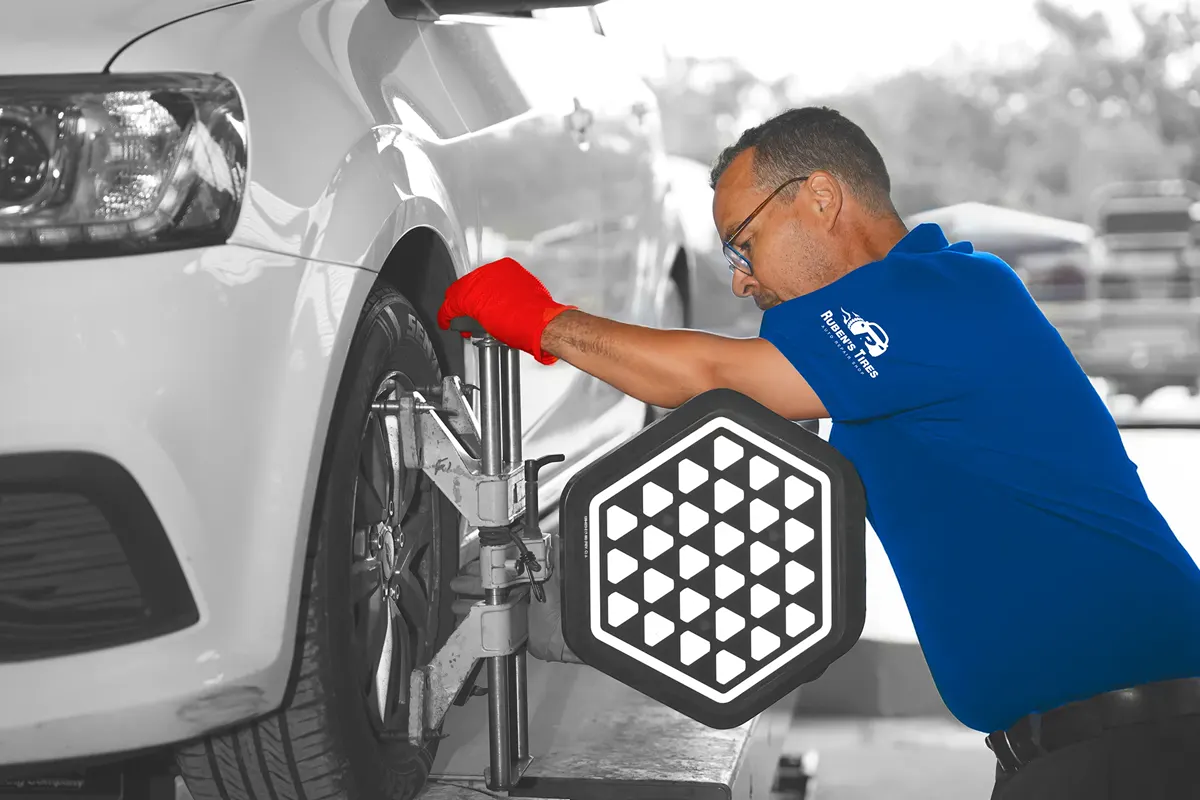
We start with your tires, because the wear pattern tells us a lot. Then we check the steering and suspension parts, so we are not aligning around a loose joint. The car goes on the alignment machine, targets go on each wheel, and the machine reads every angle. We adjust each one to your car maker's numbers, center the steering wheel and test drive the car. At our shops an alignment is often done the same day. As always, you see the price and approve it before any work starts.
Questions drivers ask
How do I know I need an alignment?
If the car pulls to one side, the steering wheel is off center, or one edge of a tire wears faster, you likely need an alignment. It is also smart after new tires or a hard hit on a curb or pothole.
Is wheel alignment the same as balancing?
No. Balancing adds small weights so a wheel spins evenly and stops a shake at speed. Alignment sets the angles of the wheels so the car drives straight and the tires wear evenly.
Can you align a car with worn suspension parts?
Not in a way that lasts. A worn tie rod, ball joint or bushing lets the angles move again. We check those parts first and tell you what we find before any work starts.
All four Ruben's Tires shops do wheel alignments, open 7 days a week. Read more about the parts behind your wheels on our suspension and steering page, see new and used tires on our tire services page, check this month's offers, or book a visit.
Book a visit online Suspension and steering
Or book with one shop: Apopka · Altamonte Springs · South Semoran · North Semoran. Prefer to call? Every shop number is at the bottom of this page.